 Michael Döcke
25. Mai, 2011
Michael Döcke
25. Mai, 2011
For software projects with a large amount of code it is essential to emphasize maintainability. Continuous Integration Systems, such as Jenkins CI, are good instruments to simplify and monitor your builds in an automatic way. An advantage of Jenkins CI – the possibility to integrate some, possibly self-written plug-ins – is the topic of a small project that could be helpful for some Jenkins/Hudson-using developers.
SVNFolderParameterPlugin is a plug-in that provides forms for parameterized builds where you can browse in a Subversion repository for a subdirectory in a specified directory. Together with a custom check-out script, this allows building Jenkins jobs which run against arbitrary source code versions in your Subversion (e.g., in order to rebuild a tagged version). When starting the build, all subfolders will be shown in a dropdown list and the URL of the selected folder will be forwarded as a property to the build script.
Weiterlesen »
Schlagworte: Java •
jenkins •
plugin •
subversion
 Christoph Schmidt
19. Okt, 2009
Christoph Schmidt
19. Okt, 2009
When it comes to testing the GUI of Java applications, you’re typically faced with a tremendous amount of readily available testing tools for AWT and Swing, in all states of development, and all kinds of packages, be it standalone tools or some kind of plug-in to your favourite IDE. Now there’s more than just AWT/Swing. Once you start developing your first Eclipse plug-in, you’re bound to come across SWT, the GUI framework of Eclipse itself. Looking for tools capable of testing SWT-based applications is quite some task, the primary source for hints being some secluded mailing lists’ archives. The task gets even tougher when you’re setting more constraints: support for the Graphical Editing Framework (GEF) and robust Capture-Replay functionality, for example.
Weiterlesen »
Schlagworte: Eclipse •
GEF •
GUI •
Java •
QF-Test •
QFS •
RCP •
Regression •
SUT •
Swing •
SWT •
SWTBot •
Test
 Christof Müller
24. Jun, 2009
Christof Müller
24. Jun, 2009
The more complex your amf-speaking Flex app, the more painful and time consuming the act of testing and debugging your Rails controllers gets. Even if testing a specific controller method via the Flex gui only takes you a couple of clicks, it adds up. Plus, if you want to investigate how your controller reacts to unexpected, even invalid parameters, you’ll end up spending your day editing Flex code, recompiling, launching and clicking around in your Flex app – although you actually want to test your controllers. That’s bad. The issue gets even more severe if you consider the fact that Rails’ integrated functional testing environment doesn’t work with pure amf (see this thread for a very tentative try to get it working). Weiterlesen »
Schlagworte: amf •
Flex •
Rails
 Simon Biemer
7. Mai, 2009
Simon Biemer
7. Mai, 2009
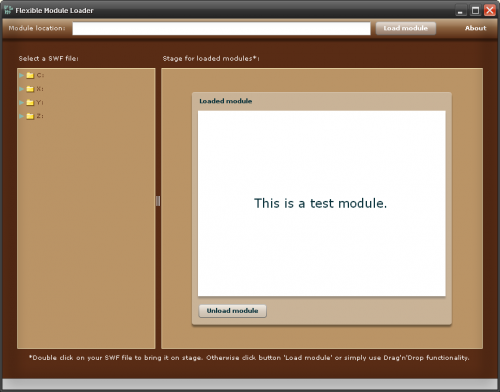 A common way to load code during run time in a Flex 3 (Air) application is using Modules. This special type of dynamically loaded SWF files allows the application to load separate parts that it requires only when it needs them. The user experiences shorter loading times due to smaller SWF file size and the developer can separate features into single modules that he can work on independently.
So far so good but unfortunately they cannot be run in a stand-alone way. Instead they must be loaded in an application. This makes it rather complicated when it comes to testing. If you have an extensive application with lots of different functionalities which are encapsulated into many different modules it can be very annoying to deploy the whole application just for testing only a small aspect. At this point the ‘Flexible Module Loader’ (FML) is going to be a very helpful tool.
Weiterlesen »
Schlagworte: Actionscript •
Air •
Flex
 Falk Hartmann
6. Apr, 2009
Falk Hartmann
6. Apr, 2009
Am 2. April hatten wir Eberhard Wolff, Regional Director der SpringSource GmbH und bekannt als die treibende Kraft hinter dem Spring Framework bei uns wie angekündigt in Dresden zu Besuch. Es war das 6. Treffen unserer Java User Group, welches fast genau ein Jahr nach dem ersten Treffen (3. April 2008) stattfand.
Weiterlesen »
Schlagworte: Java •
JUG Saxony •
OSGi •
Spring
